How a City of Two Million People Somehow Feels Like a Small Town
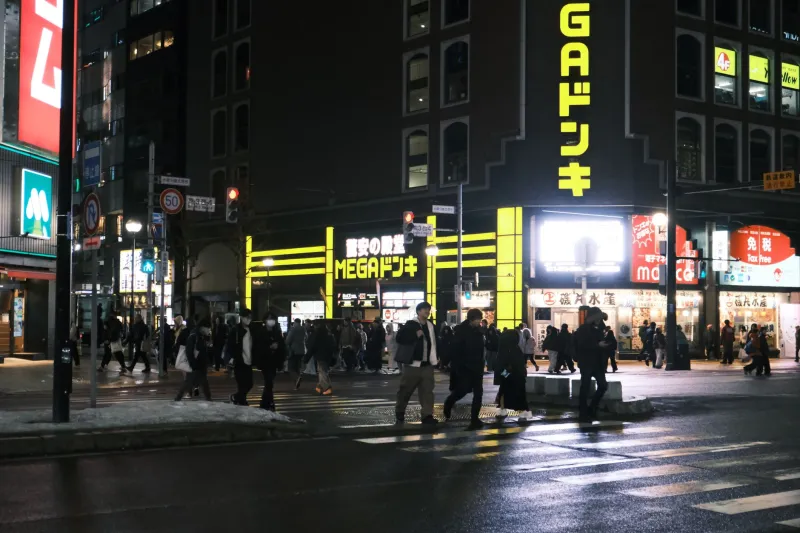
Here's something that throws a lot of American visitors off: they land in Sapporo, check the population stats on their phone — nearly two million people, Japan's fifth-largest city — and then spend the next three days wondering why it feels so much calmer than, say, downtown Denver.
It's not your imagination. And it's not just the jet lag.
Sapporo genuinely feels more spacious, more navigable, and more human-scaled than its size suggests. But understanding why requires looking past the surface and into the bones of how this city was actually built — and how the people living in it choose to move through it.
The Grid That Changed Everything
Most major Japanese cities evolved organically over centuries, layering roads on top of old footpaths, feudal boundaries, and river routes. Kyoto, Osaka, Tokyo — they're cities you have to learn, often the hard way. Sapporo is different. It was planned from scratch in the 1870s, when the Meiji government brought in American agricultural advisors to help develop Hokkaido. Those advisors brought something else with them: a grid.
The result is a street system that's almost shockingly logical by Japanese standards. Blocks are numbered. Directions are cardinal. If you can count and you know which way is north, you can find almost anything in central Sapporo without a map. That clarity does something psychological to a visitor. When you're not constantly disoriented, you stop feeling like you're fighting the city. You start feeling like you belong in it.
Compare that to navigating a place like Boston or Washington D.C., where streets seem to have been designed by someone with a personal grudge against tourists. Or even a newer American city like Phoenix, where the grid technically exists but the scale of everything — the distances, the lanes, the parking lots — makes walking feel like an act of defiance. Sapporo's grid is human-sized. You can actually use it on foot.
Wide Sidewalks, Underground Walkways, and the Art of Not Bumping Into Anyone
Sapporo's sidewalks are notably generous. Central thoroughfares like Odori give pedestrians room to spread out in ways that feel almost luxurious after the narrow, shoulder-to-shoulder footpaths of Tokyo or Osaka. But the real secret weapon is underground.
The city's covered shopping arcade network and the underground walkways connecting major subway stations mean that foot traffic gets quietly distributed across multiple levels. During the brutal Hokkaido winters, most locals migrate underground entirely, which takes a huge volume of pedestrians off the surface streets. Even in summer, the underground paths stay busy — keeping the sidewalks above from ever feeling genuinely overwhelmed.
It's a kind of invisible crowd management. Nobody planned it as a tourist comfort strategy, but that's exactly what it functions as. You can walk through Sapporo's busiest shopping district, Tanukikoji, and still feel like you have room to stop, look around, and actually think.
The Cultural Math of Personal Space
There's also something harder to quantify happening here, something cultural. Japanese cities in general — and Sapporo specifically — operate on a different set of social norms around public space than most Americans are used to.
People wait in orderly lines for the subway. Nobody's blocking the escalator. Conversations happen at a volume that doesn't carry across the street. There's no honking. There are almost no raised voices. The ambient noise level of Sapporo's streets is, measurably and noticeably, lower than in comparable American urban environments. And that quietness tricks your nervous system into perceiving more space than actually exists.
In the US, crowded means loud. It means unpredictable movement, someone cutting you off on the sidewalk, a car horn going off every thirty seconds. Your body reads all of that as density and pressure. In Sapporo, two hundred people waiting for the same crosswalk still somehow feels manageable, because the social choreography is so smooth that the crowd doesn't register as chaotic.
Parks as Infrastructure, Not Afterthought
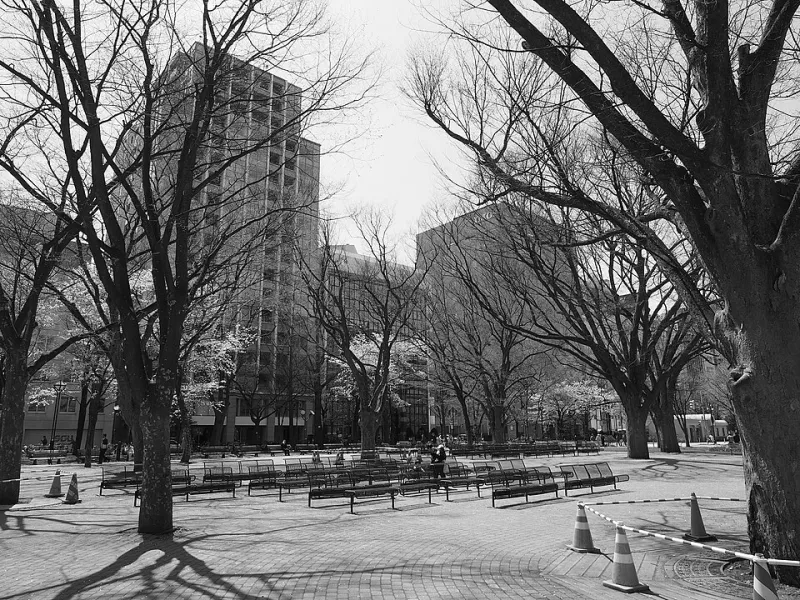
Odori Park runs for over a mile straight through the heart of the city — twelve city blocks of open green space dividing Sapporo's central grid. For Americans used to urban parks being tucked away in corners or existing as small, symbolic patches of grass between buildings, this is striking. The park isn't an amenity. It functions like civic infrastructure, a lung the city breathes through.
In summer, it fills with food stalls, festival stages, and office workers eating lunch on the grass. In winter, it becomes the main venue for the Snow Festival. It's never empty, but it's also never so packed that it stops feeling open. The scale of it absorbs people in a way that smaller parks simply can't.
This is a deliberate feature of Sapporo's original design, not an accident of geography. The planners wanted open space at the center of things. And that decision, made over 150 years ago, is still shaping how the city feels to walk through today.
Why Peak Season Doesn't Break the Spell
Here's where the Sapporo paradox really earns its name. During the Snow Festival in February, the city draws over two million visitors in roughly a week. During the summer beer garden season, Odori Park is packed every single evening. These are genuinely crowded moments. And yet most visitors — even people who've been to Tokyo during Golden Week or Times Square on New Year's Eve — still describe Sapporo as manageable.
Part of that is the underground infrastructure doing its job. Part of it is that Sapporo's attractions are spread across a wide geographic footprint rather than concentrated in one or two blocks. And part of it, honestly, is that Japanese crowd behavior just doesn't generate the same sense of friction that American crowds do.
But there's also something to be said for expectation management. Visitors arrive in Sapporo already braced for the density they experienced in Tokyo or Osaka. When Sapporo turns out to be genuinely calmer, the contrast amplifies the relief. The city doesn't have to be objectively uncrowded to feel that way. It just has to be less crowded than what you were prepared for.
What This Means for Your Trip
Practically speaking, all of this is good news. It means you can largely skip the obsessive trip-planning that other major Japanese cities require. You don't need to time your subway rides to the minute or research which days the major attractions are least swamped. Sapporo is forgiving in a way that Tokyo simply isn't.
It also means you can afford to slow down. Walk instead of taking the subway one stop. Sit in Odori Park for an hour and watch the city move around you. Wander into a neighborhood with no particular plan. The city rewards that kind of unhurried exploration in a way that genuinely crowded places can't.
Two million people live here. You might never quite believe it.